Showing posts with label dining. Show all posts

Monday, June 9, 2014

Traveling with Teens - Less Angst, More Thanks

travelsense.org

Give some parents a choice between traveling with teenagers or with a pack of hungry badgers, and they'll choose the badgers nine times out of ten. There's just something about combining unpredictable teens and close quarters that create stressful situations for those unprepared for the journey.

When faced with a long trip with their teenager, some parents simply toss an MP3 player or hand-held computer game into the back seat with their child, or allow their teen to invite a friend. While this may stop them from repeatedly asking, "Are we there yet?" it builds barriers between the child and parent, defeating the true spirit of the family vacation.

teenagers near seaTravel agents, in all their worldly experiences, see vacations as the perfect opportunity to bond with your teens, for how often do you really get a chance to spend quality time with them away from phones, TVs, video games and instant messaging? Once teens are in a different environment, even for a day trip, they often become more open and communicative.

To unlock the secrets of traveling peacefully with your teenagers, check out these tips from ASTA (American Society of Travel Agents). Some of the most travel-wise people in the world, ASTA members know that even though you don't agree on music and movies with your teen, you can all agree that hiking the Grand Canyon or watching the sun set from the deck of your cruise ship is very cool.

Space, the First and Final Frontier

Teenagers need space like fish need water. Give them space by having your travel agent select accommodations that offer more than just one room, such as a suite, or book adjacent rooms if the budget permits. Mental space is important too, so do not plan a schedule jam-packed with activities for every minute of the day. Have plenty of time for relaxing.

To teenagers, space equals privacy, and privacy is hard to come by in a cramped hotel room. Plus, the more space your teens have to get away from you, the more you'll have to get away from them.

They'll Love It When a Good Plan Comes Together 

Planning is an important step of every vacation. If you want to plan a trip your teenager will get excited about, the solution is easy: get them involved with the planning. Your teen will enjoy sifting through the guidebooks with you or researching activities online. Bring them to your travel agent's office and urge them to ask as many questions as they like.

Brainstorm with your entire family and listen to their input. Your teen may surprise you with some of things he or she might like to do on vacation. The more you show that you are listening, the more your teen will come forth with ideas. Take their interests into consideration, whether it's their love of the outdoors, history or music.

Father and Daughter FishingOnce the family plan is in place, keep your teen involved by putting them in charge of at least one aspect of the trip. If they're good with maps, make them the navigator. Do they have an eye for photos? Make them the official vacation photographer, in charge of not only taking photos during the trip, but also of compiling the album once you return. They will enjoy the responsibility of the project and the trust you give them to accomplish it.

They Love the Night Life, But They Don't Love to Boogie

Going out at night is a necessity for teenagers, so it's vital to visit an area with many nightlife options. Your travel agent will know which towns or resorts have something going on in the evening, and how to avoid quiet communities where they close the streets at 5 p.m. You should aim to go places where teens are, so that your kids can hang out with others in their age group.

Give your teens a night off. Allow older teens to go out on their own for a few hours, to just hang out at the local shops, and trust them to be back at the hotel at a designated time. For piece of mind, have your travel agent set up an international cell phone plan that can keep you and your teens constantly connected.

Even if they don't feel like going out, you can still give them the night off to simply chill out in the hotel while you enjoy the nightlife. Let them rent a movie and order room service.

Dollars and Sense

Set a budget with your teens for incidental spending and stick with it. One good idea is to make a deal with your teens, stating that they will get a percentage of the money left over at the end of the vacation. This often works in reducing the number of "I wants" that escape their lips.

Sleeping Beauties

Let your teens sleep in as much as your schedule allows. It's a win-win situation. They happily get to sleep in, and you have time for a quick nine holes on the course or a trip to the spa. 

Teens love to sleep late, and research has shown that their body clocks demand it. Try not to think of it as wasted vacation time, for letting them sleep is an easy way to eliminate tension.

Food for Thought

Part of experiencing a new destination is enjoying the local cuisine. While most travelers look forward to this savory part of world discovery, teens often fear it. Especially during international exploration, where the food can range from the exotic to the bizarre, forcing your teen to experiment day in and day out may not yield positive results.

Allow them the occasional fast food trip to cleanse their delicate palates. One great trick, travel agents tell us, is to let older teens eat on their own, especially in a foreign town. Give them enough money and set them free. This will force them to find their way around, communicate with locals and handle money responsibly. And all the while, you and your spouse can sneak off for a romantic dinner.

Just be sure to discuss with your teens to respect and obey the local customs while they're out on their own.

Take a CyberBreak

As many parents can attest to, it's difficult at times to pry your teenagers off their computers. While a vacation is a great opportunity for teens to experience the World Wide without the Web, don't force them to quit cold turkey. Make it easy for them to stay in touch with their friends back home by visiting cyber-cafés. You know you'll want to check your e-mail just as much.

Sunday, February 2, 2014

Planning A Trip With Kids: How To Save A Little Money

nonstoptravel.com
by Daniel Douglas

Planning A Trip With Kids? | Free Digital Photo by Sura Nualpradid


In fact, it’s down right healthy to take a vacation somewhere. Taking some time away is especially healthy if you have kids. Let’s be honest, kids can take a lot out of us. We may love them more than life itself, but they take a great deal out of us.

Let’s talk about planning a trip with kids.


So what do we do when we want to get away?


Well the first thing you need to determine is if this is just a trip with you and your friend (or husband) or if it’s a trip with the whole family.

If it’s a trip with the whole family then you need to consider a few things before you leave


How are you going to get there?


Well many opt for taking the car or flying, simply based on the notion that it’s easier and much simpler. But just because it’s easier and much simpler doesn’t mean that it’s the right choice. So do some calculations and look at your financials. Sometimes a train can be a really good option. If you go online and look up some of the fares that trains charge, you will find that most of them are cheaper then what you would have to afford with gas.


Save yourself some money and look into taking the train.


This can be a good thing if it’s some place close. That way you can spend time with the kids and show them the sites. If you were driving you would have to worry about what they were doing and keeping you eye on the road. You couldn’t take in the sites, like you could with a train . It would be more stressful on you. By taking the train, you alleviate that stress.

Saving up on meals


Another thing you should look into is what you will be doing when it comes to meals and snacks. When people take trips the usually say something like “Oh, I’ll just stop by the local bakery or eatery and pick something up.”

That costs money people! So save some money and pack your lunch. I know that this sounds quaint and square of me, but it really will save you money.  Brown bag some lunches for you and the kids! Fill them up with some extra goodies that they don’t normally get to eat. That way it will feel like a vacation for them.

Eat outside on a park bench, if it’s sunny. If it’s rainy, go indoors. The point is you are outside and getting some much needed fresh air. Sometimes getting that much needed fresh air is a good way to clear your head.

I do it all the time.  If I’m bothered by something, I go outside and I get a whole new perspective on things. It’s a good way to get out and meet some new friends.

Eating outside on a nearby park bench or near a museum will keep your kids activity and healthy. It will get them outdoors and they will want to run and play. As long as you keep an eye on them, both of you will fine.
It’s an inexpensive way to take a small vacation and get some peace of mind at the same time.

Just because you are on vacation, doesn’t mean you need to break the bank to do it.

Wednesday, January 15, 2014

2014 “Farm To Table Mazatlán”

by Maureen Dietrich on 14 Jan 14  
mazmessenger.com
 
Join us for a very special week in the history of Mazatlán’s food scene! The first ever “Farm To Table Mazatlán” is Monday, Jan. 27 through Sunday, Feb. 2.

For seven days, seven local restaurants will feature special menus sourced from member growers of the Mercado Organico de Mazatlán (MOM), Mazatlán’s only organic farmers market, and other Sinaloa organic growers. Individual restaurants will also present free farmer and winemaker talks, cooking demonstrations and other activities.

The week culminates in an elegant, all-inclusive Gala at a MOM member’s farm with all participating restaurants sharing the cooking and serving. Tickets are on sale now at all participating restaurants and at the Saturday Mercado Organico in Zaragoza Park, Centro Historico, from 8am to noon. Cost is 1,000 pesos per person; space is limited.

Proceeds from the Gala will go to Avicultores Pérez Vidaña, an award-winning non-profit organization in Sinaloa that assists low-income families with severely handicapped children by teaching them to raise chickens and eggs for food, and also to support the Mercado Organico de Mazatlán’s educational programs.
In alphabetical order, the participating restaurants/chefs are:

1.     Diego Becerra, Chef, El Presidio
2.     Marianne Biascotti, Owner, Rico’s
3.     Sarah Emerson & Gabriel Ocamp, Owners, Fresh International Seafood House (F.I.S.H.)
4.     Enrique Espinoza, Owner, Rosso Nero
5.     Enrique Freyre, Owner, Raggio
6.     Hector Peniche, Chef, Molika & Krema
7.     Alastair Porteous, Chef, Water’s Edge Bistro


For more information, visit www.mazatlanfarmtotable.com or the MOM Facebook page at www.Facebook.com/Mercado.Organico.Mazatlan. 

Thursday, January 9, 2014

Dining in Mexico

frommers.com

Markets & Restaurants

Exploring the culinary delights of a tianguis, or traditional market, is one of my favorite pastimes. The people-watching is top-notch, and the food stalls harbor creative surprises ranging from strawberry shortcakes covered in fresh cream to juicy cheeseburgers and onion rings. To ensure your chances of getting the healthiest food possible, visit stands that seem to be popular among the locals. Word spreads fast in Mexico, so it doesn't take long for customers to root out the stalls with less than stellar hygiene practices. On the other side of the spectrum, avoid eating at those inviting sidewalk restaurants that you see beneath the stone archways that border the main plazas. These places usually cater to tourists and don't need to count on any return business. But they are great for getting a coffee or beer and watching the world turn.

In most nonresort towns, there are always one or two restaurants (sometimes it's a coffee shop) that are social centers for a large group of established patrons. Over time, they become virtual institutions, and change comes very slowly. The food is usually good standard fare, cooked as it was 20 years ago, and the decor is simple. The patrons have known each other and the staff for years, and the charla (banter), gestures, and greetings are friendly, open, and unaffected. If you're curious about Mexican culture, these are fun places to eat in and observe the goings-on.

You'll see multitudes of taquerías (taco joints) everywhere in Mexico. These are generally small places with a counter or a few tables set around the cooking area; you see exactly how they make their tacos before deciding whether to order. Most tacos come with a little chopped onion and cilantro, but not with tomato and lettuce. Find one that seems popular with the locals and where the cook performs with brio (a good sign of pride in the product). Sometimes a woman will be making the tortillas (or working the masa into gorditas or sopes, if these are also served) right there. You will never see men doing this -- this is perhaps the strictest gender division in Mexican society. Men do all other cooking and kitchen tasks, and work with already-made tortillas, but will never be found working masa.

Dining Tips

  • Nearly all restaurants and bars that serve middle-class Mexicans use filtered water, disinfect their vegetables, and buy ice made from purified water. If in doubt, look for ice with a rough cylindrical shape and a hollow center, produced by the same kind of machinery across the country. Street vendors and market stalls are less consistent. I've never gotten sick on any of my travels to Mexico, but people who live there say a good way of keeping your stomach happy is by drinking one of the tiny Yakult yogurt drinks found in the dairy section of just about every grocery store or corner market.
  • For the afternoon meal, the main meal of the day, many restaurants offer a multicourse daily special called comida corrida or menú del día. This is the most inexpensive way to get a full dinner.
  • In Mexico, you need to ask for your check; it is considered rude to present a check to someone who hasn't requested it. If you're in a hurry, ask for the check when your food arrives.
  • Tips are about the same as in the U.S. You'll sometimes find a 15% value-added tax on restaurant meals, which shows up on the bill as IVA. This is effectively the tip, which you may augment if you like. Just make sure you're not tipping twice.
  • To summon the waiter, wave or raise your hand, but don't motion with your index finger, which is a demeaning gesture that may cause the waiter to ignore you. Or if it's the check you want, you can motion to the waiter from across the room using the universal scribbling motion against the palm of your hand.

Meals

desayuno -- Breakfast.
comida -- Main meal of the day, taken in the afternoon.
cena -- Supper.
Courses
botana -- A small serving of food that accompanies a beer or drink, usually served free of charge.
entrada -- Appetizer.
sopa -- Soup course. (Not necessarily a soup -- it can be a dish of rice or noodles, called sopa seca [dry soup].)
ensalada -- Salad.
plato fuerte -- Main course.
postre -- Dessert.
comida corrida -- Inexpensive daily special usually consisting of three courses.
menú del día -- Same as comida corrida.
Degree of Doneness
término un cuarto -- Rare, literally means one-fourth.
término medio -- Medium rare, one-half.
término tres cuartos -- Medium, three-fourths.
bien cocido -- Well done.
Note: Keep in mind, when ordering a steak, that medio does not mean "medium."
Miscellaneous Restaurant Terminology
cucharra -- Spoon.
cuchillo -- Knife.
la cuenta -- The bill.
plato -- Plate.
plato hondo -- Bowl.
propina -- Tip.
servilleta -- Napkin.
tenedor -- Fork.
vaso -- Glass.
IVA -- Value-added tax.
fonda -- Strictly speaking, a food stall in the market or street, but now used in a loose or nostalgic sense to designate an informal restaurant.
Popular Mexican Dishes
a la tampiqueña -- (Usually bistec a la t. or arrachera a la t.) A steak served with several sides, including but not limited to an enchilada, guacamole, rice, and beans.
adobo -- Marinade made with chiles and tomatoes, often seen in adjectival form adobado/adobada.
albóndigas -- Meatballs, usually cooked in a chile chipotle sauce.
antojito -- Literally means "small temptation." It's a general term for tacos, tostadas, quesadillas, and the like, which are usually eaten for supper or as a snack.
arrachera -- Skirt steak, fajitas.
arroz -- Rice.
bistec -- Steak.
bolillo -- Small bread with a crust much like a baguette.
buñuelos -- Fried pastry dusted with sugar. Can also mean a large, thin, crisp pancake that is dipped in boiling cane syrup.
cajeta -- Thick caramel sauce made from goat's milk.
calabaza -- Zucchini squash.
caldo tlalpeño -- Chicken and vegetable soup, with rice, chile chipotle, avocado, and garbanzos. Its name comes from a suburban community of Mexico City, Tlalpan.
caldo xochitl -- Mild chicken and rice soup served with a small plate of chopped onion, chile serrano, avocado, and limes, to be added according to individual taste.
camarones -- Shrimp. For common cooking methods, see pescado.
carne -- Meat.
carnitas -- Slow-cooked pork dish from Michoacán and parts of central Mexico, served with tortillas, guacamole, and salsa or pickled jalapeños.
cebolla -- Onion.
cecina -- Thinly sliced pork or beef, dried or marinated, depending on the region.
ceviche -- Fresh raw seafood marinated in fresh lime juice and garnished with chopped tomatoes, onions, chiles, and sometimes cilantro.
chalupas poblanas -- Simple dish from Puebla consisting of handmade tortillas lightly fried but left soft, and topped with different chile sauces.
chayote -- Spiny squash boiled and served as an accompaniment to meat dishes.
chilaquiles -- Fried tortilla quarters softened in either a red or a green sauce and served with Mexican sour cream, onion, and sometimes chicken (con pollo).
chile -- Any of the many hot peppers used in Mexican cooking, in fresh, dried, or smoked forms.
chile ancho -- A dried chile poblano, which serves as the base for many varieties of sauces and moles.
chile chilpotle (or chipotle) -- A smoked jalapeño dried or in an adobo sauce.
chile en nogada -- Chile poblano stuffed with a complex filling of shredded meat, nuts, and dried, candied, and fresh fruit, topped with walnut cream sauce and a sprinkling of pomegranate seeds.
chile poblano -- Fresh pepper that is usually dark green in color, large, and not usually spicy. Often stuffed with a variety of fillings (chile relleno).
chile relleno -- Stuffed pepper.
chivo -- Kid or goat.
cochinita pibil -- Yucatecan dish of pork, pit-baked in a pibil sauce of achiote, sour orange, and spices.
col -- Cabbage. Also called repollo.
consomé -- Clear broth, usually with rice.
cortes -- Steak; in full, it is cortes finas de carne (fine cuts of meat).
cuitlacoche -- Variant of huitlacoche.
elote -- Fresh corn.
empanada -- For most of Mexico, a turnover with a savory or sweet filling. In Oaxaca and southern Mexico, it is corn masa or a tortilla folded around a savory filling and roasted or fried.
empanizado -- Breaded.
enchilada -- A lightly fried tortilla, dipped in sauce and folded or rolled around a filling. It has many variations, such as enchiladas suizas (made with a cream sauce), enchiladas del portal or enchiladas placeras (made with a predominantly chile ancho sauce), and enchiladas verdes (in a green sauce of tomatillos, cilantro, and chiles).
enfrijoladas -- Like an enchilada, but made with a bean sauce.
enmoladas -- Enchiladas made with a mole sauce.
entomatadas -- Enchiladas made with a tomato sauce.
escabeche -- Vegetables pickled in a vinegary liquid.
flan -- Custard.
flautas -- Tortillas that are rolled up around a filling (usually chicken or shredded beef) and deep-fried; often listed on a menu as taquitos or tacos fritos.
gorditas -- Thick, fried corn tortillas, slit open and stuffed with meat or cheese.
horchata -- Drink made of ground rice, melon seeds, ground almonds, or coconut and cinnamon.
huazontle -- A vegetable vaguely comparable to broccoli, but milder in taste.
huitlacoche -- Salty and mild-tasting corn fungus that is considered a delicacy.
jitomate -- Tomato.
lechuga -- Lettuce.
limón -- A small lime. Mexicans squeeze them on everything from soups to tacos.
lomo adobado -- Pork loin cooked in an adobo.
masa -- Soft dough made of corn that is the basis for making tortillas and tamales.
menudo -- Soup made with beef tripe and hominy.
milanesa -- Beef cutlet breaded and fried.
mole -- Any variety of thick sauce made with dried chiles, nuts, fruit or vegetables, and spices. Variations include m. poblano (Puebla style, with chocolate and sesame), m. negro (black mole from Oaxaca, also with chocolate), and m. verde (made with herbs and/or pumpkinseeds, depending on the region).
pan -- Bread. A few of the varieties include p. dulce (general term for a variety of sweet breads), p. de muerto (bread made for the Day of the Dead holidays), and p. Bimbo (packaged sliced white bread).
panuchos -- A Yucatecan dish of masa cakes stuffed with refried black beans and topped with shredded turkey or chicken, lettuce, and onion.
papas -- Potatoes.
papadzules -- A Yucatecan dish of tortillas stuffed with hard-boiled eggs and topped with a sauce made of pumpkinseeds.
parrillada -- A sampler platter of grilled meats or seafood.
pescado -- Fish. Common ways of cooking fish include al mojo de ajo (pan seared with oil and garlic), a la veracruzana (with tomatoes, olives, and capers), and al ajillo (seared with garlic and fine strips or rings of chile guajillo).
pibil -- See cochinita pibil. When made with chicken, it is called pollo pibil.
picadillo -- Any of several recipes using shredded beef, pork, or chicken and onions, chiles, and spices. Can also contain fruit and nuts.
pipián -- A thick sauce made with ground pumpkinseeds, nuts, herbs, and chiles. Can be red or green.
poc chuc -- A Yucatecan dish of grilled pork with onion marinated in sour orange.
pollo -- Chicken.
pozole -- Soup with chicken or pork, hominy, lettuce, and radishes, served with a small plate of other ingredients to be added according to taste (onion, pepper, lime juice, oregano). In Jalisco it's red (p. rojo), in Michoacán it's clear (p. blanco), and in Guerrero it's green (p. verde). In the rest of Mexico, it can be any one of these.
puerco -- Pork.
quesadilla -- Corn or flour tortillas stuffed with white cheese and cooked on a hot griddle. In Mexico City, it is made with raw masa folded around any of a variety of fillings (often containing no cheese) and deep-fried.
queso -- Cheese.
res -- Beef.
rompope -- Mexican liqueur, made with eggs, vanilla, sugar, and alcohol.
salbute -- A Yucatecan dish like a panucho, but without bean paste in the middle.
sopa azteca -- Tortilla soup.
sopa tarasca -- A blended soup from Michoacán made with beans and tomatoes.
sope -- Small fried masa cake topped with savory meats and greens.
tacos al pastor -- Small tacos made with thinly sliced pork marinated in an adobo and served with pineapple, onion, and cilantro.
tamal -- (Not "tamale.") Masa mixed with lard and beaten until light and folded around a savory or sweet filling, and encased in a cornhusk or a plant leaf (usually corn or banana) and then steamed. Tamales is the plural form.
taquitos -- See flautas.
tinga -- Shredded meat stewed in a chile chipotle sauce.
torta -- A sandwich made with a bolillo.

Tuesday, January 7, 2014

Staying Healthy in Mexico

frommers.com

For the latest info on health risks when traveling to Mexico, and what to do if you get sick, consult the U.S. Department of State's website (www.travel.state.gov), the CDC website (www.cdc.gov), or the World Health Organization website (www.who.int).

General Availability of Healthcare

In most of Mexico's resort destinations, you can usually find healthcare that meets U.S. standards. Care in more remote areas is limited. Standards of medical training, patient care, and business practices vary greatly among medical facilities in beach resorts throughout Mexico. Cancún has first-rate hospitals, for example, but other cities along the Caribbean coast often do not. In recent years, some U.S. citizens have complained that certain healthcare facilities in beach resorts have taken advantage of them by overcharging or providing unnecessary medical care. On the other hand, Mexican doctors often spend more time with patients than doctors do north of the border, and may be just as good for less cost. Only rudimentary healthcare is generally available in much of Chiapas, Tabasco, and the Yucatán.

Prescription medicine is broadly available at Mexico pharmacies, and many drugs that in the U.S. require a prescription can be obtained in Mexico simply by asking. However, be aware that you may still need a copy of your prescription or may need to obtain a prescription from a local doctor.

Over-the-Counter Drugs in Mexico -- Antibiotics and other drugs that you'd need a prescription to buy in the States are often available over the counter in Mexican pharmacies. Mexican pharmacies also carry a limited selection of common over-the-counter cold, sinus, and allergy remedies. Contact lenses can be purchased without an exam or prescription.

Common Ailments

Sun/Elements/Extreme Weather Exposure -- Mexico is synonymous with sunshine; much of the country is bathed in intense sunshine for much of the year. Avoid excessive exposure, especially in the tropics where UV rays are more dangerous. The hottest months in Mexico's south are April and May, but the sun is intense most of the year.

Dietary Red Flags -- Travelers' diarrhea -- often accompanied by fever, nausea, and vomiting -- used to attack many travelers to Mexico. (Some in the U.S. call this "Montezuma's revenge," but you won't hear it called that in Mexico.) Widespread improvements in infrastructure, sanitation, and education have greatly diminished this ailment, especially in well-developed resort areas. Most travelers make a habit of drinking only bottled water, which also helps to protect against unfamiliar bacteria. In resort areas, and generally throughout Mexico, only purified ice is used. If you do come down with this ailment, nothing beats Pepto Bismol, readily available in Mexico. Imodium is also available in Mexico and is used by many travelers for a quick fix. A good high-potency (or "therapeutic") vitamin supplement and even extra vitamin C can help; yogurt is good for healthy digestion.

Because dehydration can quickly become life-threatening, be careful to replace fluids and electrolytes (potassium, sodium, and the like) during a bout of diarrhea. Drink Pedialyte, a rehydration solution available at most Mexican pharmacies, or natural fruit juice, such as guava or apple (stay away from orange juice, which has laxative properties), with a pinch of salt added.

The U.S. Public Health Service recommends the following measures for preventing travelers' diarrhea: Drink only purified water (boiled water, canned or bottled beverages, beer, or wine). Choose food carefully. In general, avoid salads (except in first-class restaurants), uncooked vegetables, undercooked protein, and unpasteurized milk or milk products, including cheese. Choose food that is freshly cooked and still hot. Avoid eating food prepared by street vendors. In addition, something as simple as clean hands can go a long way toward preventing an upset stomach.

High-Altitude Hazards -- Travelers to certain regions of Mexico occasionally experience elevation sickness, which results from the relative lack of oxygen and the decrease in barometric pressure that characterizes high elevations (more than 1,500m/5,000 ft.). Symptoms include shortness of breath, fatigue, headache, insomnia, and even nausea. Mexico City is at 2,240m (7,349 ft.) above sea level, and a number of other central and southern cities, such as San Cristóbal de las Casas, are as high as or even higher than Mexico City. At high elevations, it takes about 10 days to acquire the extra red blood corpuscles you need to adjust to the scarcity of oxygen. To help your body acclimate, drink plenty of fluids, avoid alcohol, and don't overexert yourself during the first few days. If you have heart or lung trouble, consult your doctor before traveling to places above 2,400m (7,872 ft.).

Bugs, Bites & Other Wildlife Concerns -- Mosquitoes and gnats are prevalent along the coast and in the Yucatán lowlands. Repelente contra insectos (insect repellent) is a must, and you can buy it in most pharmacies. If you'll be in these areas and are prone to bites, bring along a repellent that contains the active ingredient DEET. Another good remedy to keep the mosquitoes away is to mix citronella essential oil with basil, clove, and lavender essential oils. If you're sensitive to bites, pick up some antihistamine cream from a drugstore at home.

Most readers won't ever see an alacrán (scorpion). But if one stings you, go immediately to a doctor. The one lethal scorpion found in some parts of Mexico is the Centruroides, part of the Buthidae family, characterized by a thin body, thick tail and triangular-shaped sternum. Most deaths from these scorpions result within 24 hours of the sting as a result of respiratory or cardiovascular failure, with children and elderly people most at risk. Scorpions are not aggressive (they don't hunt for prey), but they may sting if touched, especially in their hiding places (which can include shoes). In Mexico, you can buy scorpion-toxin antidote at any drugstore. It is an injection, and it costs around $25. This is a good idea if you plan to camp in a remote area, where medical assistance can be several hours away. Note that not all scorpion bites are lethal, but a doctor's visit is recommended regardless.

Tropical Illnesses -- You shouldn't be overly concerned about tropical diseases if you stay on the normal tourist routes and don't eat street food. However, both dengue fever and cholera have appeared in Mexico in recent years. Talk to your doctor or to a medical specialist in tropical diseases about precautions you should take. You can protect yourself by taking some simple precautions: Watch what you eat and drink; don't swim in stagnant water (ponds, slow-moving rivers, or wells); and avoid mosquito bites by covering up, using repellent, and sleeping under netting. The most dangerous areas seem to be on Mexico's west coast, away from the big resorts.

On occasion, coastal waters from the Gulf of Mexico can become contaminated with rapid growth in algae (phytoplankton), leading to a phenomenon known as harmful algal bloom or a "red tide." The algal release of neurotoxins threatens marine life and can cause rashes and even flulike symptoms in exposed humans.

Although red tides happen infrequently, you should not enter the water if you notice a reddish-brown color or are told there is a red tide.

Tuesday, October 15, 2013

Vecinos Con Carino Day Pass Social at the Riu!


Vecinos Con Cariño will hold their 2nd Annual Day Pass
Social in the Riu Emerald Bay Hotel Sunday, Oct. 20th,
from 9 a.m. to 4 p.m. Tickets are $500 pesos per person
and include a breakfast buffet, or continental breakfast,
a lunch beffet and snacks and drinks.

Tickets are available from:


Victoria Huff - venus82000@yahoo.com
Helen James - james.helen383@gmail.com
Sue & Dave Parker - suedavidparker@yahoo.com
Arlene Johnson - ajpm411@gmail.com
Kimberly Brown - ktchrkb@yahoo.com

and the Mazatlan Membership Library in Centro

Reservations and Prepayment required by Oct. 18, 2013

*Please show your ticket at the Riu entrance, proceed
to reception where your ticket will exchanged for a
wristband beginning at 9:00 a.m.

Thursday, October 10, 2013

Invitan a desayuno anual de la Cruz Roja

Aplicarán los recursos recaudados para remodelar la clínica local y adquirir una nueva ambulancia
 
Yesenia Zermeño
noroeste.com
10-10-2013


MAZATLÁN._ El próximo 16 de noviembre se llevará a cabo el desayuno anual de la Cruz Roja Mazatlán, recursos que se utilizarán para la remodelación del Hospital Lucila Medrano y la adquisición de una nueva ambulancia.

La coordinadora de las Damas Voluntarias, Esther Osuna de Maldonado, informó que se prevé la asistencia de mil 500 personas, al igual que el año pasado.

El Centro de Convenciones de Mazatlán será el escenario donde se desarrollará el evento, que incluye una rifa de regalos y el desfile de modas que presentará la tienda Liverpool, además de la Gran Expo Navideña, detalló.

"Es a partir de las 8:00 (horas) y el costo del boleto es de 220 pesos, quienes deseen participar en los stands de manualidades pueden hacerlo, están a tiempo, lo que buscamos es apoyar con la remodelación del hospital, que se da cada dos años, que abarca los pisos, paredes, cortinas, camillas", indicó.

Los interesados en echarle la mano al grupo de damas voluntarias y solidarizarse con la causa sólo deben de llamar al teléfono 985 1451 y solicitar sus boletos y se les harán llegar a domicilio, destacó.

La Cruz Roja Mazatlán cuenta con nueve ambulancias, pero ante la demanda se requiere de al menos otra ambulancia, por ende es necesario este tipo de eventos para obtener los recursos necesarios y adquirir este tipo de elementos, agregó.

"Están invitados todos los lectores, aún falta más de un mes, pueden ir juntando el dinero, nuestro teléfono está a su disposición, nosotros les llevamos a domicilio el boleto, ojalá nos puedan seguir apoyando".

BOLETO A DOMICILIO

Para asistir al desayuno anual de la Cruz Roja Mazatlán, el 16 de noviembre a las 8:00 en el Centro de Convenciones, solicite sus boletos al 985 1451 y se le harán llegar a domicilio. El costo es de 220 pesos.


Sunday, October 6, 2013

Historic Mexican port city goes for comfort over glitz, offers great travel value

 
By Irene Middleman Thomas, Vancouver Sun October 5, 2013
 
When it comes to making memories, Mexico's Mazatlan has your number.
If it feels familiar, maybe it's because Mazatlan has been catering to tourists for half a century. If it feels comfortable, perhaps it's because it lacks the glitz of other, newer resorts. If the pockets feel full, it's because Mazatlan still pleases its visitors with very reasonable prices, unlike many Mexican resort towns.

Mazatlan doesn't try to compete with the luxury of Cancún, the sexiness of Acapulco or the colonial quaintness of Puerto Vallarta. It doesn't need to.

The popular destination, almost 1,300 kilometres south of Tucson, Ariz., on Mexico's Pacific coast, lies at about the same latitude as Hawaii.

A port city of some 500,000 residents, Mazatlan happily swells to accommodate the 1.5 million vacationers, sport fishermen and snowbirds who flock to it each year.

Its waters are neither turquoise nor crystal clear, but they are delightfully gentle and warm, and a pretty blue, with beaches stretching for miles.

Mazatlan is one of Mexico's oldest tourist resorts and home to one of the world's three major Mardi Gras carnivals, comparable only to those in New Orleans and Rio de Janeiro.

Boasting the biggest commercial shrimping fleet in Latin America, with over 500 boats, Mazatlan also has one of the largest tuna fishing fleets in the world.

Visitors, however, often feel they are in a small beach village rather than a large city, due to the way Mazatlan separates its commercial and business sectors from its resort areas.

The city's existence doesn't revolve around tourism - it is a thriving metropolis. In fact, thousands of people live and work here without having anything to do with the travel industry. For tourists, however, Mazatlan offers an abundance of riches: One of the longest stretches of uninterrupted beaches in Mexico; water temperatures between 65 and 75 degrees Fahrenheit (18 to 24 degrees Celsius) year round; nightlife set to music ranging from mariachi to disco to piano bar to salsa; colonial architecture; a wealth of handicrafts; and an endless supply of sidewalk and seaside restaurants.

The city, first settled in 1531 by the Spanish, began to really develop in the mid-19th century. To see Mazatlan as the Mazatlecos do, take one of the open-air jitneys (pulmonias).

Or stroll the impressive 20-kilometre boardwalk (malecón) between Playa Olas Altas and Playa Norte. The breezy stretch, studded with impressive statues and monuments, is the pride of Mazatlan, running from one end of the town to the other.

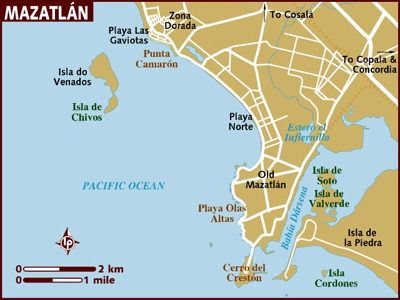
Here visitors will find the hotel zone, fishermen selling their catch at dawn, lovers embracing, locals gossiping and entrepreneurs selling coconuts, shrimp brochettes and mangoes on a stick, dripping with lime juice. The walk takes holidayers past Mazatlan's outstanding aquarium and into Old Mazatlan's Plazuela Machado (Machado Square) the  heart of the city.

On the north side of the plaza is a strip of open-air seafood restaurants. One of the most famous is lively Pedro y Lola's, named after two famous singers and actors from Mazatlan, Pedro Infante Cruz and Lola Beltrán.

Pedro & Lola's wide variety of shrimp platters is reasonably priced and delectable. Grilled with butter and garlic, "camarones al mojo de ajo," downed with a good Mexican beer like the local Pacifico lager or the heavier Negro Modelo, is heaven after a day on the beach.

Time is also well spent admiring the twin-spired cathedral (built in 1875,) the city's main plaza and the beautifully restored Angela Peralta Theatre (built in 1860.). The theatre is a beautiful, neoclassical-style building named after the beloved 19th-century opera diva who died after her only performance in Mazatlan, struck down by yellow fever.

Strolling on the way to Playa Olas Altas, travellers pass by El Puerto Carranza, an old Spanish fort.
The stroll can conclude at High Divers Park, where young men climb to a towering platform and plunge to the sea below. This happens in the late afternoons, typically but is not an everyday occurrence.

The most famous beaches in Mazatlan are Playa Norte, popular with locals, Playa Sábalo and Las Gaviotas on the resort strip, Playa Olas Altas and Las Brujas for surfing and high waves and Playa los Cerritos, one of the city's finest uncrowded beaches on the north end of the hotel zone.

Lively Sábalo Beach is perfect for jet skiing, windsurfing, parachuting, sailing, sport fishing, etc., while the adjacent Cerritos Beach and Playa Norte are known for clean sand and peaceful sunbathing. Mazatlan's Emerald Beach area to the north is being developed as a tony area with posh shops, hotels and restaurants. There's a beach perfect for every mood - romance, action, peace, adventure and people-watching.

Like most sections of Mexico, this area is quite hot and humid from July through September, and likely to have strong rains. The weather from October through May is delightful. It is recommended to have a sweater handy in the evenings, which can be cool due to the humidity and ocean breezes.


Wednesday, September 25, 2013

15 golden rules to live by while traveling the world


mylittlenomads.com


1. Don’t eat at corner restaurants — they don’t have to be good to get a lot of traffic so they probably aren’t.

2. Eat different cuisines than the country you’re in. And I’m not referring to the lasagna from your hotel restaurant. Thai food in India is different than in Thailand – obviously. But it’s also different than Thai food in Seattle. I’ve had great Mexican food in Athens, great Greek food in Bangkok, and some stuff I didn’t recognize on a Biman Airlines flight while over Pakistan. But more than good, these meals were interesting — and that’s what travel should be.

3. Steal soap from your hotel and give it to kids in developing countries as a present. Studies have shown that distributing soap to kids in poor countries saves lives. Travelers are always thinking up things to give to kids that ask for handouts (pencils, erasers, candies) but nothing beats the gift of clean hands. And don’t just collect 1 or 2 from your hotel bathroom. Hit the hallways while the cleaning staff are having a smoke and grab a couple handfuls from the service carts. When you’re saving lives, Go Big.

4. Arrive and depart from different cities. Time and money are to the traveler what cigarettes and phone calls are to the political prisoner, and you’ll be spending both of these as you return to your departure city for the flight home. Tailor your trip around two big cities, say Paris and Rome, and work your way from one to the other — and then fly home directly.

5. Read a local newspaper. Most countries and big cities have at least one english language newspaper. You’ll be amazed how involved you’ll become in local affairs in just a week or two of following the current scandal, or election, or controversy about school prayer (that’s not just an American thing).

6. Don’t take any one person’s advice for important decisions. This is called anecdotal evidence. “I went to Kenya and didn’t take malaria medicine and man, I was fine.” All this means is that it’s possible to visit Kenya, without anti-malarials, and not die. It doesn’t mean it’s smart, advisable, or even likely. Just possible.

7. Err on the side of inexpensive hotels. This goes against most travelers’ natural inclinations. We talk a good game above traveling frugally, but once we get on the road we tend to spend up a bit, and treat ourselves. And that’s fine. This rule isn’t about saving money. It’s about having an interesting trip and the more expensive a place is, the more likely it will have package tourists and people traveling on 7 or 14 day tickets. Nothing against these people but if you want to swap stories about taking a boat through the backwaters of Kerala, go with the cheap place. If you want to talk about who’s going to win the Superbowl this year then go with the package tourists.

8. Don’t shy away from big events. It’s tough to fit this into a rule as there are so many variables. If the Olympics are on and you show up looking for a room, yeah, you’re screwed. But many events scare away more people than they attract. Especially if the locations bounce around a bit (e.g. the World Cup of Soccer).

9. Only travel with people you live with. If you want to hook up with your old buddy’s family, don’t do a trip through Tuscany. There’s just too much to negotiate. This is hard enough between two adults who share, uhm, a marriage. Throw in two more adults, a couple more kids and it becomes impossible and not much fun. If you really want to do something special with friends, book a place for a week or two, roast a pig, eat leftovers. No trouble.

10. Don’t be afraid of admitting what you don’t know. I was traveling once through the Sinai to Israel and I caught myself thinking “Is English the main language in Israel?” Nah, it couldn’t be, but, what is it then? When the bus stopped and I hopped out, I heard the border guards talking and no, dear reader, it wasn’t English. I could be embarrassed about this, but I’m not. Everyone is ignorant of something but some people sit at home watching Fox News and have their opinions confirmed and some people go out into the world and look stupid and look naive and learn and grow and become better people. (And Gosh darn it I’m gonna be one of them!)

11. Do what you want to do. Don’t let someone else — or a guide book — decide. If you don’t want to see the Louvre then don’t see it. Do Paris or London or Rome the way you want to do it. I went through Cairo and didn’t see the pyramids. And while this isn’t a great example, seeing as I’ve regretted that egg-headed decision every day since it occurred — I can live with it. It makes it my trip and my memories and my damn stupid decision.

12. I’m going to have to be the one to break this to you. If you’re taking a trip — especially an extended trip — you’re going to have hard days, challenging days, lifeless, languid, listless days. (Thank you Webster’s New World Thesaurus!) That’s fine. Just don’t blame your bad days on traveling. You have bad days at home. You wake up and feel groggy and grumpy and lazy and lethargic. (Those were mine.) It’s not necessarily the trip that is making you feel this way. It’s the fact that you’re human. Process it. Deal with it. Accept it. — Now go get yourself a banana pancake.

13. Buy your own fruit. It sounds simple. It is simple. Just do it. You’ll love it. And I don’t mean, if there happens to be a fruit stand outside your hotel door you should buy some, because you need to have 9 servings a day.  What I mean is, find fruit and buy it. Make it a daily task that you’re going to track down a fruit stand, a farmers’ market (they’re not just in San Francisco) and get some good fresh fruit. The entire process will expose you to elements of daily life you would have otherwise ignored. Trust me: You’ll have memories from your trips to buy fresh fruit.

14. Use a small pocket camera. Leave your 10 pound camera that’s the size of a football at home and take a point and shoot model that isn’t much bigger than a deck of cards. Yes, you’ll miss some shots — not enough light, too much light, won’t focus quickly enough — but you’ll have it with you all the time, you won’t be as reluctant to take it out in an intimate or awkward setting, and people will act much more naturally even when they do notice it.

15. Send postcards. They’re fun. People like getting them. If you must send an email put all the contents in the subject line: “Mom — I’m alive, in Italy, not going back to school next semester. XO”


Monday, September 9, 2013

Tips for Women Travelers to Mexico


about.com
 By Suzanne Barbezat,
 
 
Although men and women have equal rights by law in Mexico, and more and more women work outside the home and hold public office, traditional ideas still dominate in many areas. This should not deter you from traveling to Mexico on your own. You can have a great time and learn a lot, just remember that your safety is your top priority and consider these tips to avoid harassment and stay safe.

Dress like the locals

Mexicans tend to dress conservatively, and if you would like to avoid unwanted attention, it's a good idea to do likewise. In coastal areas, shorts and tank tops are acceptable, but inland, women usually wear pants or skirts.

Arrive during the day

If at all possible, get a flight or bus that allows you to arrive at any new destination with enough daylight hours left in the day for you to find your hotel and get oriented.

Look like you know where you're going (even if you don't)

Don't stand on the street looking at your map or guidebook. Ask for directions at your hotel or in a store or restaurant. Write down the directions, or draw a small map on a piece of paper that you can consult without other people noticing.

Ignore catcalls

If men call out to you on the street, the best thing you can do is to just keep walking, don't respond and avoid making eye contact. Any response from you, even a negative one, will be seen as an invitation to continue the interaction.

Put your safety before your budget

Choose a hotel in an area that feels safe to you, even if it costs more. Your security and comfort are worth it, and you will enjoy your trip a great deal more.

Curb your alcohol intake

If you're traveling on your own, you need to keep your wits about you. Drink only in the company of people you trust. Remember that at higher altitudes you may feel the effects of alcohol more rapidly.

Beware of "gabacheros"

This is a term used for a Mexican man who makes a career out of pursuing foreign women. He may want sex or the things a foreign woman can afford: dinner in nice restaurants, a trip to the beach or even to her country. If you enjoy the company and don't mind footing the bill, go ahead, just don't be fooled about his intentions.

Learn a few phrases

If you don't speak Spanish, at least learn a few phrases that you can use if you are being harassed. The phrase "Estoy esperando a mi esposo," (I'm waiting for my husband) works surprisingly well to get rid of unwanted suitors.

Also, know how to ask for help: "Ayudeme, por favor." Say this directly to someone nearby if you're being harassed and need help. Many Mexicans will avoid getting involved in a situation unless they are asked directly.

Practice general precautions against theft

Don't wear expensive jewelry and keep any valuables in your hotel's safe or carry them on your body, under your clothes. Keep your money in a few different places. Wear comfortable shoes so you can run if necessary.

Trust your instincts

If a person or situation feels uncomfortable, get away fast. Don't worry about being rude. Your safety is so much more important than being nice.


Wednesday, September 4, 2013

Results in for 2013 Tourist Satisfaction Study

Tourists spent 1,182 pesos per person, 10 percent less than last year.


Results of the third consecutive annual survey of tourists to Mazatlán conducted by Codesin zona sur and the Tres Islas Hotel Association were presented at a press conference yesterday.

The study found that this year tourists spent 1,182 pesos per person, 10 percent less than last year, and that at least 18 percent of visitors stayed in condominiums, departments or houses rather than hotels.

When asked what, if any, media promotion made them decide to vacation in Mazatlán, 59 percent said it was on the recommendation of family or friends, 37 percent said internet sites helped them decide and three percent said the promotion of Mazatlán during the Premios Oye! telecast was a factor.

Thirty-eight percent of vacationers arrived in Mazatlán by car, 27 percent by bus, 28 percent by air and seven percent via charter tours.

And while 93 percent of tourists rated Mazatlán as a good or excellent holiday destination, the remaining seven percent criticized the city´s image as being ugly and dirty with deteriorating sidewalks, constant approaches by vendors and poor quality in hotels and restaurants.

Despite the seven percent with complaints, the study reported 99 percent of those surveyed would return to vacation in Mazatlán and 98 percent said they would recommend the port. Pleasant people, a secure vacation spot and extraordinary beaches were the criteria on which they based their decision to return.

The study was conducted from July 18 through August 16 with interviews of 400 men and women over the age of 18 staying in an hotel for at least two nights who had participated in the decision to vacation in Mazatlán.

 (from Noroeste)

Tuesday, August 20, 2013

Budget Travel in Mexico

 travelindependent.info/america-north.htm


México

* Miss at your peril: (stay away from the crowds) - 'Highlight of Independent Travel'

  • Intro: Viva México! It's huge and has tons to offer! Right across the spectrum, from the nadir of Cancún to the zenith's of Palenque, Oaxaca (Wa-ha-ka) and Porto Escondido to mention a few. México's size has two major effects on travellers. One good, one not so. Firstly [the good] the sheer size of the country and its variety means that with some effort you can find many gems and have them completely to yourself, in addition to the fact that there are many great things to see and do without even venturing off the beaten track.
Mexico 

The downside from the country's size (and terrain which is far from flat) is the necessity to spend many hours on buses of which the cost of can seriously mount up - even more so if you take advantage of the better services. For example the six hour journey from México City (N.B. referred to as México City here, but really just México or México DF) to Oaxaca on a premier bus will blow the daily budget of any budget traveller and then some. It is common to hear backpackers throughout the Americas moan at just how expensive México is and wonder how locals can afford to live. It is not that México is expensive, I mean far from it when compared to the super power to the north, but in relation to the rest of Central America it is more pricey in the same way as Brazil, Uruguay and Argentina use to be to South America, and just like these countries it is transport and tourist hot spots that get you. Lets take the Yucatan for example, Cancún is nearer to Miami than México City and has many daily direct charter flights from Europe.


Such an influx of tourists, many who have considerable (by Mexican and backpacker standards), money to spread about is bound to push prices up. In addition the rapid development in México fuelled by the NAFTA agreement has brought in standards of services (such as buses of which many are excellent) that you just don't find in most other Latin American countries. For increased quality comes increased prices. Lets go back to that seemingly expensive bus journey from México City to Oaxaca. The bus will have AC, movies and the road is excellent. Much cheaper alternatives exist, of course you don't get AC and a movie, but you don't even get the same road since the good one is a toll road that the cost of using is the main contributor of the cost of your ticket. So take the cheaper bus if you want it to take twice as long. Let's be fair in the big scale of things the extra money is probably worth it. The analogy works with most things such as seemingly expensive food and accommodation.
Enjoy México for the right reasons (take touristy attractions especially the Yucatan, like the tequila - with a pinch of salt), learn some Spanish, get off the beaten track and enjoy for along with Guatemala it is a real highlight of this region and one of the world's most underrated country's.

Highlights & Lowlights:

  • Highlights: The a traditional route from the Capital South towards Central America will take in the following highlights: México City (inc. surrounding areas such as Teotihuacán), Palenque, Oaxaca* and Porto Escondido - but that's only the tip of the ice berg. As a general rule of thumb the main tourist focus of the country is the Yucatán (where there's plenty to explore) and with direct flights from Europe and North America this is an obvious entry point for package tourists seeking sun/sea and backpackers heading for central America.

    Those who enter the country at Mexico DF* the greatest temptation is to head South towards the well known aforementioned highlights and to Central America. Distances and/or limited time often put those heading this way off routes to the North and West of the capital. Discount or write off these routes at your expensive... among the less crowded highlights are: Guanajuato, a phenomenal colonial city, more Spain than Spain, great tunnels, architecture, mazes of alleys, college culture and street actors. Zacatecas, the beauty of this city at sunset can't easily be described; the food and museums are cheap and world class. The architecture is a great mix of Mexican and Moorish. Accommodation is great and seemingly hardly anyone on the circuit in Mexico gets here.

    San Miguel de Allende, despite the hype that its full of Americans, it rarely is. A great cathedral, wonderful cheap authentic food, perhaps the best nature preserve in all Mexico (the botanical gardens - over hundreds of acres - above town), one of the best hostel owners/hostel in Mexico, mellow street life, calm mornings, great art scene and Spanish schools await those who visit. Morelia, a colonial gem with amazing local artisans and street life, cathedrals are world class, food (try the sopa tarasca) is to die of.

    Another gem, abet a bit more well known is Real de Catorce, a little tiny town in the mountains of North Mexico. Very popular with the backpacker crowd due to its otherworldly landscape (the Mexican with Brad Pitt was filmed here) and Peyote usage by local Indians (and of course travellers), this little town has horseback riding (3$ US an hour) into the local mountains and deserts, a hippie market, and the place looks like a Sergio Leone/Clint Eastwood film. The journey itself is a highlight, with a bus along on the world's longest cobblestone road, into a one way tunnel through a mountain.

    Diving - On a world scale, there is some truly superb diving in Mexico. You can dive the cenotes in the Yucatan through caverns with stalagmites, stalactites and haloclines - it really is an incredible experience and pretty unique. There is also excellent reef diving on Cozumel, in Baja California, and you can snorkel with whale sharks in Holbox and Isla Mujeres.

    Many thanks to Eric Beecroft and Jason for sharing there expert knowledge here.

  • Lowlights: If you are 21 or under have limited taste, possibly American, you will love Cancún. For most it's one of those loathsome place with only novelty value and nothing (unless you have a big budget to keep you there). Playa de Carmen and Cozumel Island are not far behind. The rate of change in these places on the Caribbean coast of the Yucatan is unbelievable. See them to believe them. Large parts of the Yucatan are not so bad as to avoided.

    Another common complain along with the crowds and modernisation in tourist hot-spots is the simple fact that México is not a shoestring budget country when compared to Central America and long distances on buses kill a budget. On a more critical side not everyone is smitten by the highly and definitely over rated San Cristóbal de las Casas, where due to the history of up-risings and military presence in the area many of the 'cooler' travellers head to hang out and do little. San Cristóbal de las Casas is to backpackers what Cancún is to package tourists - a Mecca in México. For that reason if you don't have time to 'hang-out' or wind your way there on the bus you could happily give it a miss and spend your time elsewhere such as some of the great places listed above in the highlight section.

    Last, but not least the border towns of Tijuana and Cuidad Juarez (across from El Paso, Texas) are definite lowlights where trouble is extremely easy to find.
  • Visa strategy: Tourist cards are issued free for 90 days at entry points for most nationalities.
  • Myan 

    Typical tourist trail: The majority of tourists disregard the north of the country (above México City) which is mainly dry and harsh and not particularly rich in highlights. Unless they are making trips from America into the spectacular scenery of Baja California or to the Copper Canyon (which are both highlights). The vast majority of tourists fly into the Yucatan and spend there time there. Those with a bit more time may start in México City which is brimming with things to see and do. From there a typical path may head either directly to Oaxaca or to the coast at Acapulco (or further north) and then down along the coast to Porto Escondido and then up to Oaxaca. From Oaxaca the trail heads to Palenque, either via Villahermosa or Cristóbal de las Casas. For here on either Guatemala or the many amazing temple sites of the Yucatan will call you.
  • Costs: Costs vary hugely for México depending on where you are and what you are doing. On the two ends of scale lets use Cristóbal de las Casas and Cancún for example, the latter and around US$30 won't get you too far especially if you want a drink or two. In the former lazing around in a hammock you would be hard pressed to spend half the Yucatan amount living pretty good. There is a definite tourist economy, with high prices and sometimes, unhelpful service. To avoid this as much as possible and find places used by locals a good understanding of Spanish really makes a difference. Another certain key to budget travel in Mexico is planning a good circuit route so as to backtrack as little as possible and keep those fund killing bus trips to a minimum.
  • Money: ATMs are plentiful through-out much of the country and are a far more convenient way to carry money than travellers cheques. Any funds you take with you should be in USD. Credit cards can be used in some circumstances and are worth having.

  • Getting around: México has a highly developed bus system with many different options and of course considering its size a large network of internal flights. Taking into consideration how developed the bus system is most will favour this rather than taking internal flights. For flying the most popular and recommended option is México City to Cancún or vice versa as this is a hell of a long way to backtrack if you have a flight out of say Cancún.

    • With regards to buses the subject could fill a web site alone. The system is both complicated and confusing and trying to understand it is impossible. Luckily you don't have to and in reality most Mexicans don't. At the end of the day anywhere you want to go there will be a bus going, you just have to find the station it goes from. Most cities have numerous stations (México DF has four). These may be split further by one for first class, one for second.. and so on. Just take it easy it is not too hard to get anywhere and buses are generally organised, clean and prompt - but no bargain.

    • There now exists three superior classes of bus plus second class buses. These are usually called Primera Plus, Futura and Ejecutiva. All these first class buses (not always all available), are excellent, but have prices about 40% higher than regular services making them really quite expensive for long journeys where you can do with the extra comfort. For most regular first class is the way to go, you still get AC, TV and a WC (for what they are worth).

    • Be aware that AC buses can get quite cool in the day and very cool at night. Have a sweater handy. Cheaper buses without AC and all the windows open are pleasant for shorter journeys. Films shown on buses are 50% of the time in English with Spanish sub-titles. When travelling over night front seats will keep you away for smelly toilets. On popular routes booking advance is often necessary and at busy times of the year (Christmas, August) very necessary, particularly in the Yucatan or in and out of México City. Due to the size of México it is more than likely you will have to do at least a few overnight trips.

    • Second class buses normally operate from a different terminal from 1st class buses and look a lot more antiquated. They call at towns and villages and use side roads that 1st class buses would never touch. For longer journeys 1st class buses are better, but on a second class bus with the windows wide open, music playing, local colour you have a great Mexican experience.

    • More info can be found in any guidebook and most major companies such as ADO (www.adogl.com.mx) have websites for more info, timetables and prices.


  • [book] 

    Guide book: The 7th edition Rough Guide is an excellent guide and our recommendation for a 'Mexico only' guide (Buy/view: in the USA (amazon.com), in Canada (amazon.ca) or in the UK (amazon.co.uk)), but so is the Lonely Planet and Footprint. The Footprint does however cover central America which may be of use to you and is therefore recommended.

  • People vibe:

    • Locals: The friendliness of locals does vary dramatically especially in an out of tourist hot spots. There is a definite anti-gringo attitude around Cristóbal de las Casas and in other areas. However, on the whole if you speak Spanish Mexicans are wonderful people.
    • Other travellers: Various. Mainly European backpackers apart from on the Yucatan where the large numbers of tourists are mainly North American.

  • Tourist factor: From 10/10 to 5/10. As with many countries, many spots get very crowded during the European/North American summer holidays and there is a signification increase in tourists/travellers.

  • Accommodation: There is a wide range of accommodation in most places from very cheap dives to more expensive very nice rooms.

    • Hot water: In hotter areas and at the cheaper end, hot water may not always be available.
    • Average cost: From US$7 to US$30 (normally about in the middle). Found many cheap places that were very dirty and noisy so took a more expensive option. Prices are higher on the Yucatan and lower in backpacker hubs.

  • Communications: Internet plentiful and good value.

  • Media:

    • Books: American newspapers and magazines on the Yucatan. Elsewhere books and newspapers/magazines are in Spanish.
    • TV: Due to its proximity to American, cable TV is wide spread and always available in better hotels and in bars in tourist hot spots on the Yucatan, where sporting events are often shown. Cinemas in major cities are good quality.

  • Food: México is all about food which outside of Asia has the best street food in the world. Don't be afraid just dive in. Smarter restaurants aimed at tourists can be quite expensive by comparison. The best value is always small family run places. The meal of the day or set menu (comida corrida - make sure they give you the menu with this on) as in the rest of Latin America is always the easiest and cheapest way to eat. There are many fast food restaurants, both Mexican and America and numerous supermarkets (with excellent bakeries) so eating cheap on the move is easy.

    • Vegetarians: Fine, although eating on street stalls and taking advantage of the cheap set meals of the day will be complicated and often not possible especially if you don't eat chicken.

  • Hassle and annoyance factor: Limited, this is not Asia.

    • Women alone: Fine on the whole. Care is required same as everywhere.

  • Drugs, cigarettes and alcohol: Fantastic Tequila and Mezcal bars, especially in Oaxaca. Great beer everywhere, but open air drinking places are not very common. Pot is plenty available in most places in particular along the pacific coast and any backpacker 'hubs'.